

A Little Care Before the Cold: Getting Our Homes Ready for Winter in Deephaven Cove
The leaves have fallen from our trees here on Valley Cove Court, and colder nights are coming. Our local forecast shows temperatures dipping below freezing Thursday, with lows around 28 degrees Friday and Saturday. With temperatures like these, we know snow and ice are on their way.
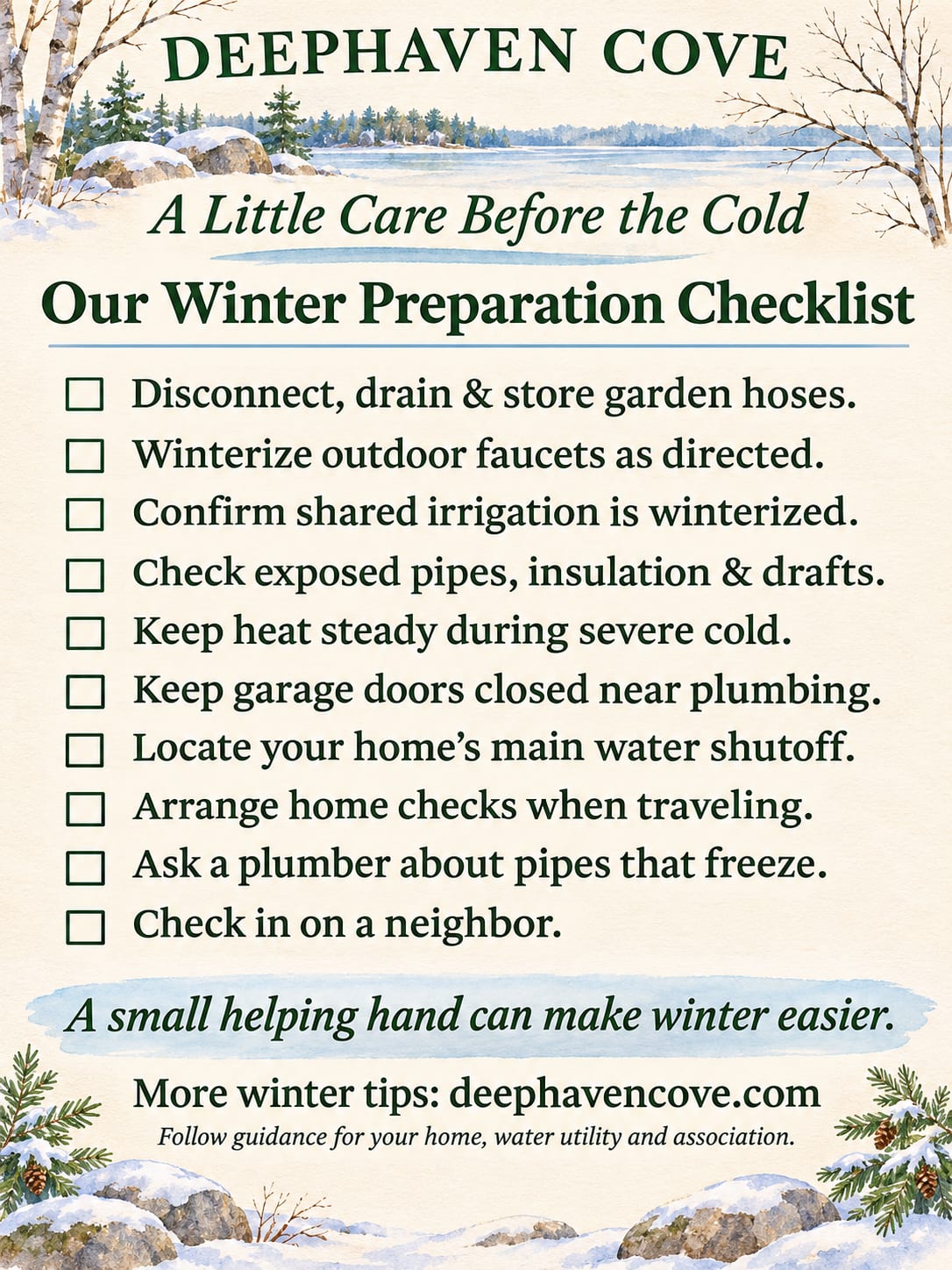
Before we settle in with a warm cup of coffee, let’s take a little time to get our homes ready. Disconnecting garden hoses, checking on vulnerable plumbing, and knowing where to shut off the water are small steps that can help prevent a difficult winter surprise.
And while we are thinking about our own homes, let’s think about our neighbors, too. Some may be spending their first winter here. Others may appreciate a helping hand with a task that has become harder to manage. A quick check-in can mean so much. That is part of what makes a neighborhood feel like home.
Begin with the garden hose
If your garden hose is still connected outside, this is a good time to disconnect it, drain it, and put it away for the season.
Outdoor faucets need attention, too. If yours has a dedicated indoor shutoff valve, turn off that supply and drain the outdoor line according to the faucet’s instructions. Different faucets have different winterizing requirements, so ask a plumber if you are unsure how yours works.
For shared irrigation systems, check with property management to confirm that winterization has been arranged. Lunseth is our contractor who does three tasks for our neighborhood. Lunseth does irrigation, mowing and snow plowing. New Concepts Management is contracted by the HOA to do this winterization task.
These are easy things to forget when autumn gives us a few extra pleasant days. Help warmth reach your pipes. Pipes near exterior walls or in poorly heated spaces are more vulnerable to freezing. Take a look beneath kitchen and bathroom sinks and around plumbing in garages, utility rooms, and unfinished areas.
During especially cold weather:
- Keep garage doors closed if water pipes run through the garage and consider shutting off the water to the garage spigot.
- Open sink cabinet doors so warm household air can reach the plumbing. Move cleaning products out of reach of children and pets.
- Keep indoor heat steady rather than turning it down sharply overnight.
- Keep the area around your water meter and incoming water line warm.
- Have drafts near plumbing addressed and consider appropriate insulation for exposed hot and cold water pipes.
Foam pipe sleeves can help protect accessible plumbing, but insulation does not replace heat. If heat cable is needed, use a listed product approved for your pipe material and location, and follow the manufacturer’s instructions carefully. A plumber can help you choose a suitable approach.
When can pipes freeze?
Water freezes at 32°F, but the outdoor temperature alone does not tell us when pipes inside a home will freeze.
Pipe location, insulation, cold drafts, indoor heating, and the length of a cold spell all matter. A brief overnight freeze does not mean every home’s pipes will freeze, but it is a useful reminder to finish seasonal preparations.
Rather than relying on a particular temperature or number of hours, pay attention to your home’s vulnerable areas and any history of freezing.
Should you leave a faucet dripping?
Sometimes—but it depends on which pipes are at risk.
The American Red Cross recommends allowing a trickle of cold water from a faucet supplied by exposed pipes during very cold weather. Hot-water lines can freeze, too, so ask a plumber how to protect both lines if your home has vulnerable plumbing.
For underground water service lines, follow your own water utility’s guidance. A slow drip intended to protect indoor plumbing may not be enough to protect a vulnerable underground service line.
Running water continuously is not necessary for every home whenever the temperature drops below freezing. It also increases water use and bills. If your pipes have frozen before, make a plan with a plumber or your utility before the next severe cold spell.
Going somewhere warm this winter?
If your winter plans take you away, leave the heat on. General winterizing guidance recommends a thermostat setting of at least 55°F, although some homes need a warmer setting to protect plumbing in colder areas.
Ask someone you trust to check your home while you are gone. Make sure they know how to reach you and where to find your main water shutoff.
For an extended absence, ask a plumber about appropriate winterization and check any requirements from your association and insurer. Turning off the water alone does not drain the pipes or fully winterize a home.
Having a neighbor who knows you are away can be a comfort, too.
Know where your water shutoff is
An emergency is a difficult time to begin searching for a valve.
Take a few minutes now to locate the main water shutoff serving your home. It is often near the water meter or where the water supply enters the building. If you are unsure which valve serves your home, ask a plumber or property management to help identify it.
Make sure the valve is accessible and that other household members know where it is.
If you suspect a frozen or broken pipe
If a faucet unexpectedly produces only a trickle—or no water—freezing may be the cause.
Contact a licensed plumber if you cannot locate the frozen section, cannot reach it safely, or are unsure what to do. Never use a torch or open flame to thaw a pipe.
If a pipe breaks or you discover a leak, shut off your home’s water supply if you can do so safely. Contact a plumber and notify property management promptly, especially if water could affect another home or a shared area. Stay away from standing water near electrical equipment.
Looking out for one another
Some of us have prepared for Minnesota winters for decades. Others are still learning what needs to be done, or finding that familiar chores take more energy than they once did.
There is no shame in needing a little help. If you have a question, ask. If you can offer a helping hand, reach out.
Sometimes caring for our neighborhood looks like planting flowers or gathering over coffee. Sometimes it looks like helping someone put away a garden hose before the cold arrives.
All of it helps make this a place where we feel cared for—and where we care for one another.
Sources: American Red Cross: Preventing and Thawing Frozen Pipes, City of Eagan: Winterizing Your Home, and City of Bloomington: Prevent Frozen Water Pipes, Meters and Sewers.
This article shares general seasonal guidance. Follow instructions specific to your home’s plumbing, your own water utility, and your association.
More from the Journal